Recycling in Mallorca: What Goes Where
Mallorca separates household waste into colour-coded street containers labelled in Catalan, and every town runs a recycling centre for everything the bins will not take. The rules are the same whether you live here or are staying in a holiday rental for a week, and once you know the colours most of it takes seconds.
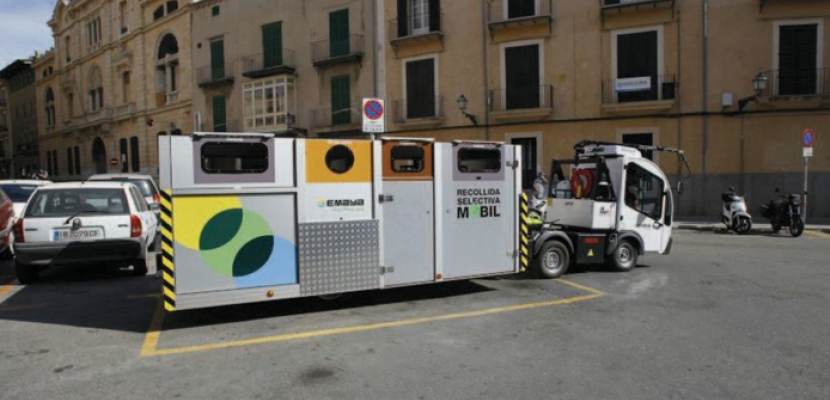
Mallorca mobile recycling bins
In Short
- Glass goes in the green bin, packaging (plastic, cans, cartons) in the yellow, paper and cardboard in the blue, food in the brown where there is one, and everything else in the grey or black.
- Batteries go in the collection boxes found in supermarkets and electronics shops, never in a street bin.
- Small electronics can be handed in free at any large electronics shop, without buying anything, or taken to a recycling centre.
- Furniture, mattresses and appliances are collected free by the town hall by appointment, or can be taken to a recycling centre.
- Medicines go to the SIGRE point in any pharmacy.
Street Bins: Which Colour Takes What
The containers carry Catalan labels. This is what each one means.
🟩 Verd (Green) — Vidre (Glass)
- What to put:
- Glass bottles (wine, beer)
- Glass jars (jam, sauces), lids removed
- Do not put:
- Ceramics or porcelain
- Mirrors or window glass
- Light bulbs (see electronics below)
🟡 Groc (Yellow) — Envasos lleugers (Light Packaging)
- What to put:
- Plastic bottles, tubs and trays
- Drinks cans and food tins
- Tetra Paks (milk and juice cartons)
- Plastic bags and film
- Do not put:
- Toys
- Kitchenware
- Packaging still full of food
🟫 Marró (Brown) — Matèria orgànica (Organic Waste)
Not every street has one yet. Where there is no brown bin, food waste goes in the grey or black bin.
- What to put:
- Food scraps
- Coffee grounds and tea bags
- Used paper napkins and kitchen roll
- Small amounts of garden waste
- Do not put:
- Plastics, including "compostable" bags unless the town hall says otherwise
- Nappies
- Animal waste
🟦 Blau (Blue) — Paper i cartró (Paper and Cardboard)
- What to put:
- Newspapers and magazines
- Office paper
- Cardboard boxes, flattened
- Do not put:
- Greasy or dirty paper, such as pizza boxes
- Laminated or waxed paper
⚫ Gris/Negre (Grey or Black) — Rebuig (General Waste)
- What to put:
- Anything that cannot be recycled
- Nappies and sanitary products
- Cigarette ends
- Broken ceramics
- Do not put:
- Recyclables
- Batteries, electronics or anything hazardous
Where to Recycle Batteries
Used batteries never go in a street bin. Look for the small collection boxes marked Piles near the entrance or the tills of supermarkets, electronics shops and DIY stores: shops that sell batteries are required to take used ones back. Town halls and every recycling centre have them too.
Car and motorbike batteries go to a recycling centre or back to a garage.
Where to Recycle Old Electronics
Anything with a plug or a battery — phones, chargers, cables, kettles, hairdryers, laptops, toys with electronics — counts as RAEE (electrical and electronic waste) and must stay out of the street bins.
- Small devices: large electronics shops must accept very small items, nothing longer than 25 cm, free of charge and without you buying anything. The collection point is usually near the entrance or the customer service desk.
- When you buy a replacement: the seller must take your old appliance back when you buy an equivalent new one, including when the new one is delivered to your home. Ask for it at the time of purchase.
- Light bulbs and fluorescent tubes: shops that sell them usually have a collection box, and recycling centres take them.
- Printer cartridges: many office supply shops collect them.
- Everything else, including large appliances: take it to a recycling centre.
Recycling Centres: Deixalleries, Punts Verds and Parcs Verds
Every municipality has at least one recycling centre. Most towns call it a deixalleria or punt verd; in Palma they are parcs verds, run by EMAYA, the city's municipal services company. They are free for household quantities and take what the street bins cannot:
- Furniture and wood
- Fridges, washing machines and other appliances
- Electronics, batteries and light bulbs
- Paint, solvents, aerosols and motor oil
- Garden waste and rubble from small DIY jobs
- Textiles and large amounts of cardboard
Bring things already sorted. Some centres limit quantities or ask for proof that you live in the municipality, so check the town hall's website first; opening days vary by town and season, and many close one day a week.
Furniture, Mattresses and Other Bulky Items
Leaving a sofa, mattress or fridge next to the street bins is not allowed and can be fined. Most town halls collect bulky items (voluminosos) free of charge by appointment: in Palma you book it with EMAYA, and elsewhere through the town hall (ajuntament). The alternative is to take them to the recycling centre yourself.
Clothes, Shoes and Household Goods
Clothes, shoes and bedding go in the textile containers marked Roba, many of them run by charities and social enterprises. Deixalles, a Mallorcan non-profit, also collects furniture and household goods in good condition for reuse.
You will often see clothes and household things left beside the bins for others to take. It is a long-standing habit, but most towns forbid leaving anything outside the containers, so the textile bins or a reuse charity are the better route.
Cooking Oil, Medicines and Other Special Items
- Used cooking oil: let it cool, pour it into a plastic bottle, close it, and put it in the orange
Oli usatcontainer or take it to a recycling centre. Never pour it down the sink. - Medicines: unused or expired medicines and their packaging go to the SIGRE collection point found in pharmacies.
- Paint, chemicals and part-full aerosols: recycling centre only.
Tips for Holiday Rentals and Visitors
- Ask your host where the bins are. Many villas and apartment blocks have their own containers, and some neighbourhoods collect door to door (
porta a porta) on set days, following a calendar. If yours does, stick to it. - Put rubbish out at the permitted time. Many towns only allow bags to be left out during set hours, usually the evening. The rules are printed on the container or on the town hall's website.
- Flatten cardboard and empty containers so they fit; an overflowing bin is the most common reason rubbish ends up on the pavement.
- On beaches, take everything home with you. Beach bins fill quickly in summer, and anything left beside them tends to end up in the sea.


Hospitals & Emergency Care on Mallorca
Mallorca 2026: Navigating changing laws and costs impacting tourists